The Age of ‘Agentic AI’
Why AMD’s EPYC 9006 CPUs are redefining the standard in data centres

Why AMD’s EPYC 9006 CPUs are redefining the standard in data centres
The demands placed on modern data centres have changed rapidly in recent years. Whilst the first major AI boom relied primarily on pure model training and brute-force GPU computing power, companies are now facing a new stage of evolution: agentic AI (autonomous AI agents).
An AI agent no longer simply generates text based on a query. It independently plans processes, searches databases, executes code, calls upon external tools and verifies results in several steps. These complex workflows are fundamentally transforming the infrastructure – and make it clear that a purely GPU-based approach falls short. This is precisely where AMD comes in with the launch of the 6th generation of EPYC server processors (codenamed ‘Venice’), supported by Supermicro’s new H15 server portfolio and by Gigabyte’s robust architectures, optimised for the AMD EPYC 9006 series.
Manufacturers such as Supermicro and GIGABYTE have specifically designed their platforms (such as Supermicro’s H15 series) to optimally fulfil the key roles of the CPU in the modern data centre:
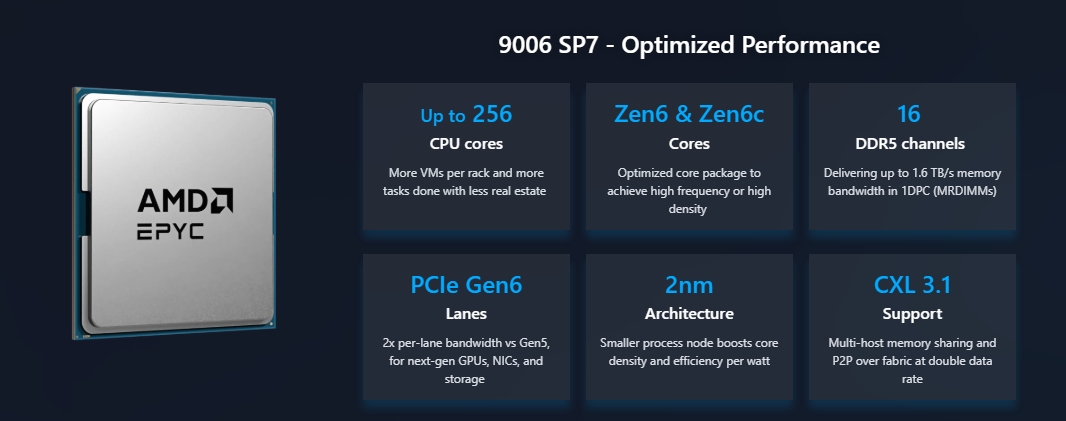
As autonomous agents require isolated, secure and highly parallel environments in which to execute code or process planning logic, this calls for an extremely high thread density. With top-of-the-range models such as the AMD EPYC 9996, offering up to 256 cores and 512 threads per socket, the new architecture delivers the scalability required to run agent workloads efficiently.
Even the most powerful GPUs are wasted if they are not supplied with data quickly enough. The EPYC 9006 platform introduces PCIe Gen 6 and supports extremely fast MRDIMM memory modules with speeds of up to 12,800 MT/s, enabling up to 2.6 times higher memory bandwidth. This minimises latency and keeps GPUs working at full capacity at all times.
Databases, orchestration and traditional enterprise applications form the backbone that AI agents access. The wide-ranging portfolio – divided into the performance-optimised SP7 and the efficient SP8 platforms – ensures that organisations can continue to carry out these tasks seamlessly.
Based on the modern ‘Zen 5’ core architecture and the SP6 socket format, the new processors offer noticeable improvements over the previous generation:
- Up to 84 cores in a single socket: Enables high-density consolidation of workloads without the complexity of dual-socket systems.
- Flexibly adjustable TDP: With a cTDP ranging from 70W to 225W, performance can be precisely tailored to the thermal conditions of the location.
- Outstanding efficiency: Compared to its 64-core predecessor (EPYC 8004), the top-of-the-range model (AMD EPYC 8635P) delivers 40% higher peak integer performance whilst offering 9.5% better performance per watt.
- High I/O bandwidth & memory: Support for 6-channel DDR5 memory (up to 6400 MT/s), as well as 96 PCIe Gen 5 lanes and CXL 2.0 for direct connection to fast NVMe drives and state-of-the-art network hardware.
- Investment security: Thanks to socket compatibility (SP6) with the EPYC 8004 series, existing platforms can be easily upgraded via a BIOS update, depending on the OEM design.
The new generations of servers offer an average performance increase of 1.7 times that of the previous generation and, thanks to their modular architectures, cover every area of application:

Umfasst Enterprise-Flaggschiffe wie die Hyper-Linie, Cloud-optimierte CloudDC-Systeme sowie hochdichte Architekturen wie GrandTwin und liquidgekühlte FlexTwin-Systeme. Ergänzt wird dies durch KI-Monster wie die 72-GPU AMD Helios Platform für großskaliges Training.

Offers a versatile range of products, from blade servers (B685-D80-LS1) through to high-density and HPC/AI servers, right through to energy-efficient edge and storage solutions, all fully optimised for PCIe 6.0 signal integrity and advanced Direct Liquid Cooling (DLC).
- What are the AMD EPYC™ 9006 server CPUs, and what architecture do they use?
The AMD EPYC™ 9006 Series (codenamed ‘Venice’) comprises 6th-generation server processors. They are based on the advanced Zen 6 and Zen 6c architectures (manufactured using the advanced 2nm process) and offer up to 256 cores and 512 threads per socket to achieve the highest computing power and core density in the data centre.
- How do the SP7 and SP8 sockets differ in the EPYC 9006 series?
- SP7 socket: The high-end flagship for the most demanding cloud, HPC and AI workloads. It supports up to 256 cores, 16 DDR5 channels (with MRDIMMs up to 12,800 MT/s) and maximises computing performance.
- Socket SP8: The platform optimised for efficiency and enterprise requirements, featuring 8 to 128 cores, 8 DDR5 channels and a high number of PCIe Gen6 lanes for an improved cost-benefit balance.
- Why are the EPYC 9006 CPUs particularly important for ‘Agentic AI’?
Autonomous AI agents (Agentic AI) require not only GPUs but also massive CPU power to coordinate agent sandboxes, execute code, call up tools and query databases in parallel. The EPYC 9006 series offers the necessary thread density for this, as well as extreme I/O and memory bandwidths to supply GPU accelerators with data without causing bottlenecks.
- What improvements do PCIe Gen 6 and the new storage standard bring?
For the first time, PCIe Gen 6 is supported, doubling the bandwidth per lane compared to Gen 5. Combined with support for ultra-fast MRDIMM modules (with memory transfer rates of up to 1.6 TB/s per socket), this drastically reduces latencies and noticeably speeds up data-intensive workloads.
- Which manufacturers offer server systems for the EPYC 9006 series?
Leading server manufacturers such as Supermicro (with its new H15 server platform and systems such as Hyper, CloudDC and GrandTwin) and GIGABYTE (with specialised blade, high-density and GPU servers) offer a comprehensive portfolio that is fully optimised for the EPYC 9006 architecture and direct liquid cooling (DLC).