From the AI Factory to the Workplace
What NVIDIA GTC Berlin 2026 Means for Businesses

What NVIDIA GTC Berlin 2026 Means for Businesses
At NVIDIA GTC Berlin 2026, Jensen Huang delivered a clear message: AI is no longer an experiment, but is becoming the core infrastructure of businesses. His keynote centred on the idea of the ‘AI factory’ – AI not as a single model, but as a productive system comprising computing power, networking, storage, software and data management. The key insight: infrastructure must be in place before models can be created – much like the electricity grid preceded electrification.
Sovereign AI was one of the dominant topics. Huang emphasized that sovereignty means controlling your own data and staying capable of acting on it. Europe – and Germany in particular – should not just consume AI but produce it. NVIDIA announced investments in European AI initiatives and pointed to partnerships with the German government as well as companies like Siemens and Mercedes-Benz.
A second focus was on agentic AI systems. These are systems that combine models with tool use, planning logic, and feedback loops to handle multi-step tasks independently. For businesses, this means AI agents are moving closer to productive processes – and with that, questions of security and control come to the fore.
Security was treated as an engineering discipline, not just a policy matter. With the OpenShell Reference Architecture and NVIDIA Sentry on BlueField-4 DPUs, companies gain runtime control over autonomous agents. The division of labor is clear: agents "think" on Rubin GPUs, "act" through harnesses on Vera CPUs, and are monitored on BlueField-4 DPUs. Sentry can quarantine agents within milliseconds if they leave their software boundaries. OpenShell relies on kernel-level sandboxing and is backed by a broad partner ecosystem – including Red Hat, Canonical, SUSE, CrowdStrike, SAP, ServiceNow, as well as major model and cloud providers like OpenAI, Anthropic, Meta, Microsoft, AWS, Google Cloud, and IBM. Banks such as BBVA and Santander are also among the partners.
In the Agentic AI space, NVIDIA introduced new Nemotron models (Super VL, Bolt, Retriever family), the Agent Knowledge Foundation, and the NemoClaw blueprint for agent optimization. One important distinction: NemoClaw has been available since March 2026 and was built for the OpenClaw community – a one-command installation that combines Nemotron models and OpenShell to make agents run securely and locally. In Berlin, it was not introduced as new, but placed in the broader agentic AI context.
Another new building block in the AI factory space was DSX POD: a modular container reference design for complete Vera Rubin AI factories, shipped pre-built and validated. On-site deployment drops from up to six months to around 14 days. Partners include Dell, HPE, Lenovo, GIGABYTE, Bull, Foxconn, Pegatron, Quanta Cloud Technology (QCT), Wiwynn, Schneider Electric, and Vertiv; availability is slated for early 2027. According to NVIDIA, the new generation delivers 30x more agentic performance per megawatt and 30x more tokens per dollar compared to GB300 NVL72 – and saves up to 30 percent power at the same token throughput through intelligent power management.
Last but not least, the keynote addressed physical AI – robotics, manufacturing, automotive, and heavy industry. Huang's pointed phrasing: "Electrons will never replace atoms." The next wave of AI is physical, and Germany, with its industrial base, is a key stage for it. NVIDIA presented extensive updates for Cosmos, Isaac Lab, Omniverse libraries, vehicle platforms (Hyperion, Halos SAFE, Alpamayo 2), and robotics. One point of context: Cosmos 3 and Alpamayo 2 were already announced at GTC Taipei in May 2026 and were positioned here within the European context.
A concrete European example came from Agile Robots, which presented the Agile ONE SN – a robotics development platform scheduled for release in 2027, demonstrated at GTC Berlin. Microduck from Hugging Face and Pollen Robotics was also officially confirmed: the small robotic duck is built with NVIDIA Isaac Lab, Isaac Sim, and Newton, showing how accessible the entry into the Sim2Real pipeline has become.
In the automotive sector, Volvo, Mercedes-Benz, and Volkswagen are betting on the Hyperion platform. In addition, Bolt, the European ride-hailing platform, plans to deploy at least 25,000 Level-4-capable robotaxis – with Germany as a priority market.
In telecommunications, Deutsche Telekom has validated the commercial AI-RAN platform from Nokia and NVIDIA in Bonn and Oulu, including AI-enhanced uplink channel estimation; field tests are planned for 2027. Other operators include Fastweb and Vodafone in Italy, Kazakhtelecom, Orion in Serbia, and Cassava in Africa. At GTC Berlin, Agile Robots also demonstrated how AI-RAN and physical AI work together: on-robot intelligence for real-time perception, edge models for fine-tuning, and central infrastructure for larger training workloads.
The keynote highlighted a clear trend: AI is becoming physical—in robotics, manufacturing, and industrial facilities. For companies, this means a growing need for computing power for simulation and training, such as for transferring simulated models into the real world.
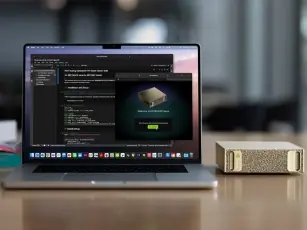
The NVIDIA DGX Spark is already part of our portfolio. It allows development teams to run AI workloads locally – without cloud dependency, with full data control, and without ongoing cloud costs. The keynote confirms this approach: sovereign AI starts where teams keep control over their data and infrastructure.
Our customers in regulated sectors – healthcare, manufacturing, public sector – need solutions that run AI in their own data centers and retain data sovereignty. As a vendor-independent provider (NVIDIA, Gigabyte, Supermicro), we can deliver exactly that: hardware integration and on-site support from a single source.

The keynote named a clear trend: AI is becoming physical – in robotics, manufacturing, and industrial systems. For businesses, this means growing demand for compute power for simulation and training, for instance for transferring simulated models into the real world. This also touches our core topic: HPC infrastructure. We have been working on designing and operating compute-intensive systems for years – a foundation that is likely to be increasingly in demand for physical AI. The step toward industrial AI that NVIDIA outlined also expands our application spectrum in simulation and training.
The “five-layer cake” of AI infrastructure can also be seen as a story of scalability: from the DGX Spark for entry-level use, to gigabyte-class workstations at the departmental level, all the way to HGX B200 servers for clusters and AI factories. We help customers choose the right scale—and grow along with them.

A photo that caused a stir at GTC Berlin 2026: Jensen Huang stands on stage in front of an entire “robot parade.” In the background are humanoid robots from Agility Robotics and Enchanted Tools; in the foreground—barely larger than a laptop—is Microduck, the tiny robot duck. Microduck is an open-source robot from Hugging Face, measuring just 25 centimeters tall. It can walk, sit down, and pick up objects with its beak. What might sound like a toy at first is actually a strategic move for the AI world: With such affordable and accessible hardware, developers worldwide gain a low-threshold entry point into the Sim2Real pipeline—that is, the transfer of simulated training into the real physical world. To this end, Hugging Face provides simulation environments, training data, and scripts free of charge on its platform. For us at sysGen, this development is more than just a nice anecdote. It vividly illustrates just how broad the landscape of physical AI has become: from ecosystem entry (Microduck) to commercial production (Agility Digit) to service interaction (Enchanted Tools). And it highlights what all these systems have in common—they require a robust infrastructure. Whether it’s local training on the DGX Spark, departmental workstations, or HGX-B200 servers for large-scale model development: the journey from the “duck” to a productive AI application begins with the right hardware and data control.